


The global landscape of AI is undergoing a profound transformation, marked by a shift from the experimental ‘First Wave’ of chatbots to a ‘Second Wave’ of autonomous, agentic systems that create real-world economic value. While the US has long held a perceived lead through massive capital investment and frontier research into Artificial General Intelligence (AGI), China is rapidly closing this gap by pursuing a radically different trajectory. This strategy is built on pragmatic industrial integration and consumer adoption of agentic AI, leveraging its vast consumer data and abundant energy, and grounded within its distinct ‘cosmotechnics’. As China embeds its AI directly into its digital society and economy, all the way from electric vehicles to smart grids and consumer applications, it is building its own AI-Stack that offers an affordable alternative to Western models, particularly for the Global South.
China’s ascent in the AI domain is driven by a focus on practical utility and cost-efficiency rather than the focus on developing AGI. The main idea behind this strategy is that the AI race will not be determined solely by who builds the most advanced model or leads at the technological frontier. Instead, as with other general purpose technologies, the country, society, economy that has the best use cases and most widespread adoption of the technology will be considered the ‘winner’ in this sense. In other words, the conditions that enable AI to translate into real-world impact are just as important and that is where China’s focus is. In this sense, being AI-ready encompasses a broad range of conditions, such as having the necessary digital infrastructure, data ecosystems, user acceptance, workflows, as well as having real opportunities where AI can add real value. Being able to seamlessly embed AI into one’s economy and social fabric may therefore ultimately outperform those that focus primarily on pushing the limits of model capability alone.
A primary catalyst for this is the development of highly efficient, low-cost models in China. A standout example was last year’s DeepSeek, a Chinese open-source model that shocked the global tech community by being ten times more efficient than OpenAI’s models while consuming significantly less energy. Built without the massive funding or elite university backing typical of Silicon Valley, it demonstrated that the frontier of AI is also shifting toward usability and resource optimization. In general, Chinese models are often open-source and more resource-efficient, although falling behind compared to the capabiities of their many American rivals (although the trailing time has been reduced to just seven months).
This efficiency is also critical because energy is increasingly becoming the hard limit for AI development; datacenters and AI-agents create a permanent, massive demand for electricity. As AI systems scale and consumer adoption rises, electricity supply is quickly emerging as a critical bottleneck. Data centers are becoming some of the most energy-intensive infrastructures in the world, straining the existing grids that are already reaching their limits and increasing operational costs. And the shift toward real-time AI applications further amplifies this demand, especially in the case now with agentic AI like OpenClaw. The lack of abundant, reliable, and affordable energy means that the growth and development of AI systems risks being constrained by these physical resource limits.
China’s dominance in green energy infrastructure thus provides a strategic backbone for its AI ambitions. The country leads the world in solar panels, wind turbines, and lithium-ion batteries, having reached its 2030 renewable capacity targets six years ahead of schedule. This abundance of renewable technology allows for a green tsunami of cheap power that can sustain large-scale AI operations. Furthermore, Chinese industries are already integrating AI to optimize this energy nexus, with companies like Huawei developing AI driven grid-forming systems that manage renewable generation and storage under a unified digital platform.
Beyond efficiency and energy, China leverages massive data and rapid consumer adoption to iterate its AI systems at an unmatched pace. Unlike the West, where AI adoption is often slowed by ethical debates and regulatory caution, Chinese consumers exhibit a rational optimism, viewing AI as a pragmatic tool to improve daily life. The rapid adoption of OpenClaw, to which Chinese engineers refer as ‘raising a lobster’ shows this (Chinese AI models have now overtaken their US rivals in terms of token consumption). This creates another powerful feedback loop: as millions of users integrate AI into their daily routines, the systems accumulate data and refine their capabilities, further accelerating China’s move up the AI value chain.
China’s approach to AI is not merely a technical pursuit but is deeply rooted in its own narrative and cosmotechnics. The main idea of cosmotechnics is that the concept of technology aligns with a country’s specific cultural, political, and philosophical foundations rather than following a universal (and often Western-centric) path. Building on the work of Chinese-German philosopher Yuk Hui, the idea of cosmotechnics suggests that every technological system carries implicit values about order, knowledge, and human purpose. So rather than converging toward a single global model, different societies and economies can cultivate distinct technological trajectories that are thus shaped by their own histories and metaphysics. In China’s case, this results in AI systems oriented toward harmony, coordination, and collective optimization. While the Western AI narrative often views AI through a ‘Promothean’ lens — either as a tool of individual liberation or a potentially threatening superintelligence — China views AI as a means of collective coordination and state-led social and economic optimization.
This cosmotechnical vision also integrates Confucian values, emphasizing long-term goals, shared interests, and social order. This aims to the Confucian ideal of a ‘benevolent technocracy’ where AI is used to manage societal infrastructure, such as food logistics and public health, with a precision that Western models, hampered by data individualism, may struggle to match. In this narrative, AI is not an actor intended to ‘overcome’ humanity but an infrastructure of alignment that ensures social stability and economic resilience. This is of particular interest as China faces the challenges of an aging population and rising labor costs, and China tries to avoid the so-called ‘middle-income trap’.
This is codified in the strategy of developing ‘new productive forces,’ a concept introduced by President Xi in 2023 to leverage scientific advancement for high-quality economic growth. The focus is on the real economy and how to make physical industries smarter, such as mining, manufacturing, and medical diagnostics. Rather than the virtual world of image generation and storytelling, China is trying to get real productivity and efficiency gains. For example, while Western AI often struggles to move past the pilot phase in business, Chinese AI is being embedded directly into the production lines of electric vehicles (EVs) and heavy industry to drive Total Factor Productivity (TFP).
This long-term orientation is reinforced by China’s new emphasis on coordinated planning and the policy principle of ‘Common Prosperity,’ which seeks to distribute the gains of technological progress across society. Through state-led investment, industrial policy, and regional pilots, AI deployment is not left solely to market forces but guided toward strategic sectors and public value creation. This enables faster scaling and alignment between innovation and societal goals, ensuring that productivity gains from AI are more broadly integrated into economic development rather than concentrated within a narrow set of firms or industries.
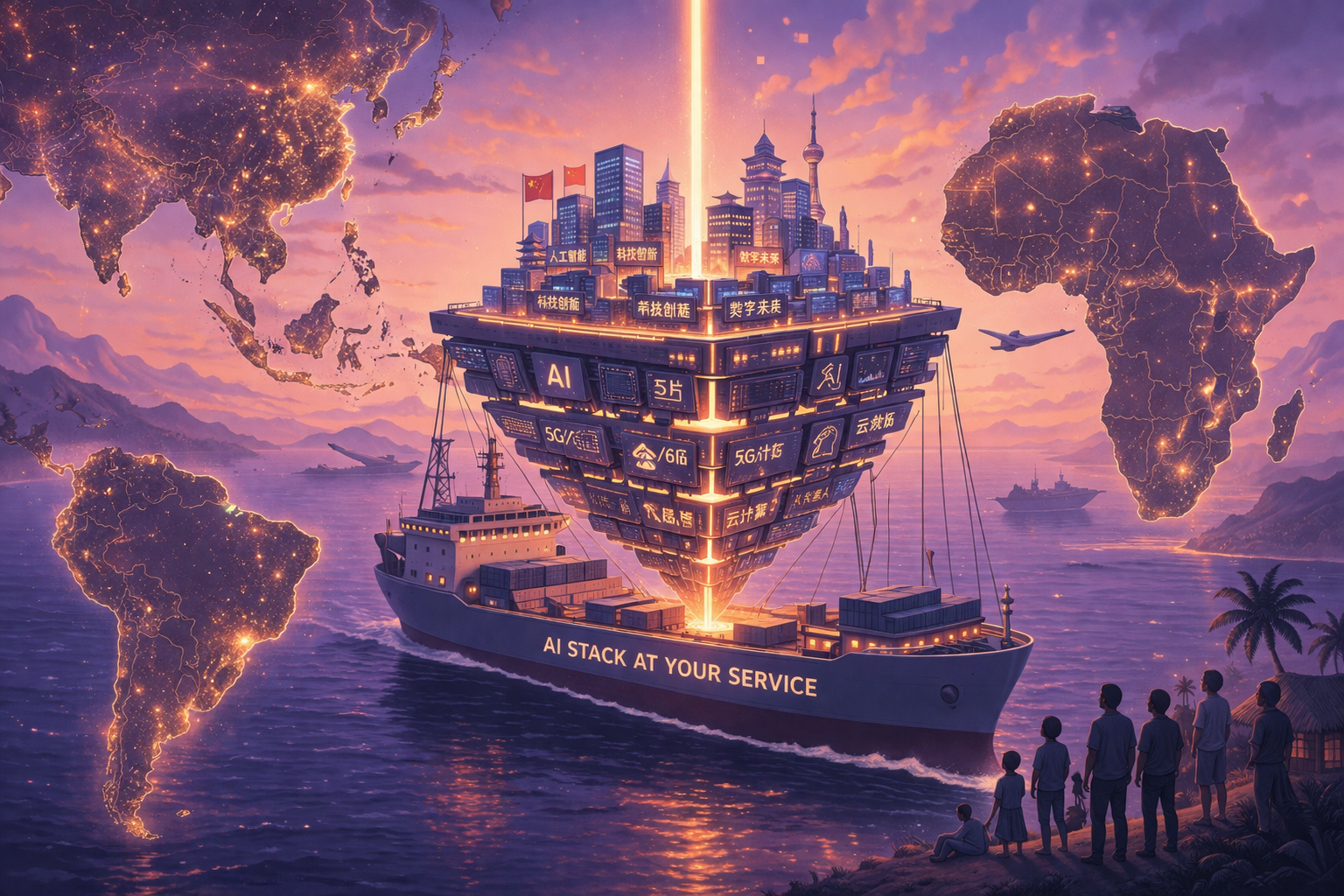
This combination of pragmatically focusing on real-world impact and value-creation has led to the rise of a distint China AI-Stack that is integrating hardware, digital infrastructure, applications, and energy systems. China is using this Stack to facilitate the AI demands of other nations. This holds especially for developing countries, as for many developing nations, affordability, real-world value and resoure-efficiency are more important than having access to the best frontier models.
As such, Chinese firms like Huawei, Tencent, and Alibaba are aggressively expanding their footprint in regions like Southeast Asia and the Middle East, by building datacenters and forming joint ventures that embed Chinese technological standards into the local economies. For example, China could export these along the Digital Silk Road, the technological pillar of its flagship foreign policy and investment project. As Chinese AI increases its holds in the Global South, this could create a dual AI world order: a US-led Stack focused on frontier research and high-margin profits, and a China-led Stack focused on infrastructure and mass accessibility.
China further enhances this soft power by framing its AI breakthroughs as technological gifts to the world. For example, Baidu has a patent for AI that translates animal sounds, which could be exported to rural economies in Africa or Asia to help farmers manage livestock or protect endangered species. By applying AI to socially resonant domains like healthcare, education, and agriculture, China positions itself as a partner in sustainable development rather than just a vendor of consumer electronics.
The success of the China Stack is also visible in the entertainment sector, where AI-powered movie productions like Ne Zha 2 have become global hits. This demonstrates that AI is democratizing content creation, allowing smaller, AI-supported collectives to challenge the historical dominance of Hollywood. As these practices scale, Chinese AI platforms could become leading standards; for example, low-cost, highly integrated content productions are increasingly replicated by studios in Asia and Latin-America seeking efficiency and speed. If Chinese cultural products could gain international influence, they carry with them Chinese perspectives on talent, mastery, and collective identity. This growing cultural and technological influence is reflected in the emerging trend of ‘Chinamaxxing,’ where developers and consumers globally adopt Chinese tools, workflows, and optimization strategies.
The divergence between the US and China in AI development suggests a future where the world is split into distinct technological spheres. By focusing on cost-effective, (agentic) AI that is deeply integrated into the real economy and supported by a green energy supply chain and robust industrial strategy and backbone, China is providing a viable model that many developing countries are willing to replicate to escape to transcend the middle-income trap. Ultimately, the race for AI supremacy may not be won by the best frontier models, but by the ones that are best in the adoption, often of the most useful, cost-efficient, accessible, energy-efficient, models into the daily lives global consmers and businesses. In this regard, China’s pragmatic, full-AI Stack approach could boost its global influence in the coming years.