

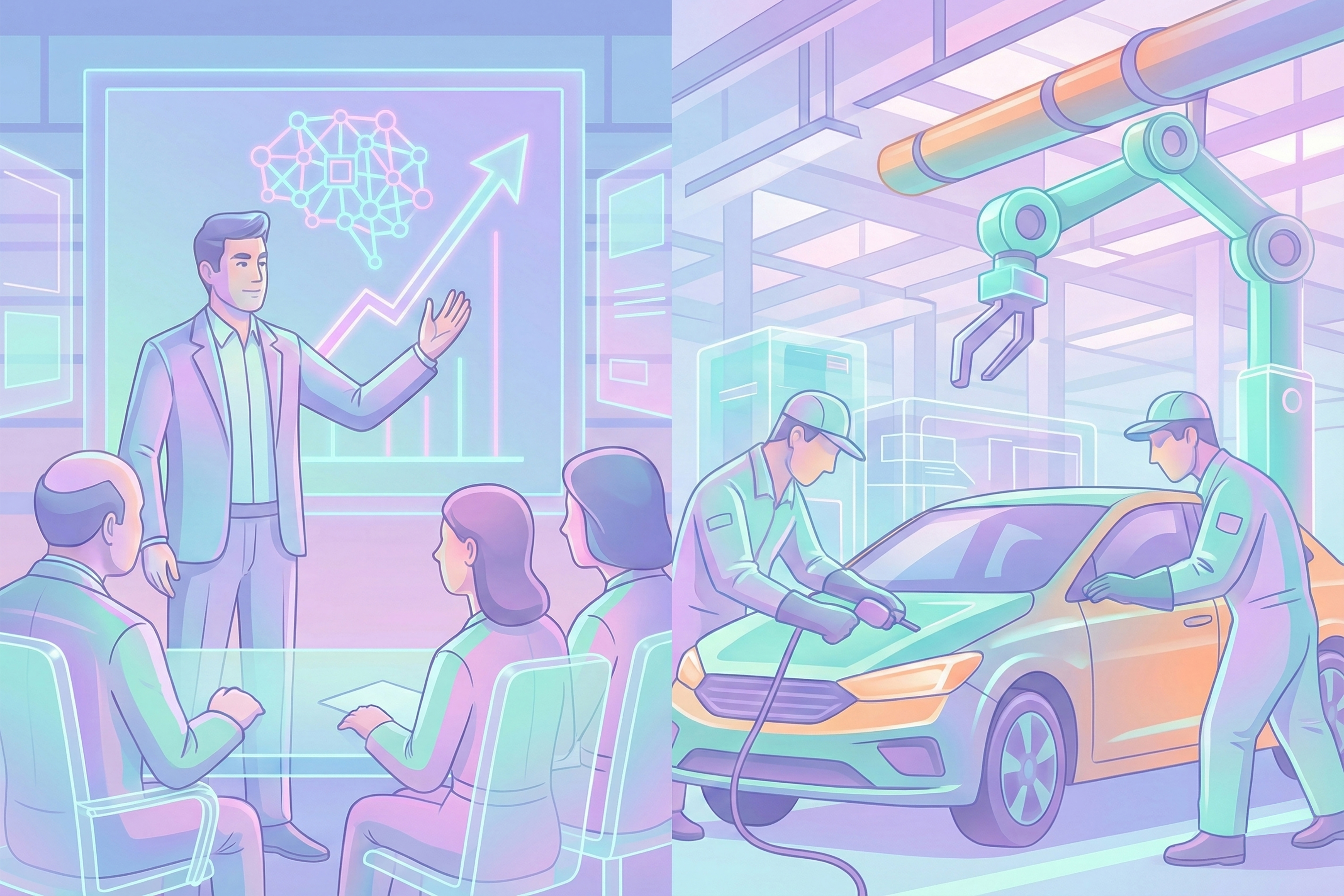


The global AI race has moved far beyond who can build the flashiest or most benchmark-crushing model. A deeper structural divide has opened between the world’s two dominant powers. In the US, a capital-fueled boom in large language models and cloud computing has ignited soaring expectations of imminent breakthroughs. China, by contrast, is layering AI into the physical economy, such as EVs, ports, and mining, where cost efficiency and mass deployment matter more than distant visions of Artificial General Intelligence. This split is reshaping markets and could define the next world order. Europe, once again, finds itself in the middle: should it go all-in on superintelligence or commit to applied, real-world AI?
In recent weeks, concerns about an emerging AI bubble have intensified across major financial institutions. Report after report, article after article, the same headlines keep appearing. The Bank of England has warned that AI-related valuations have reached levels that could pose risks to financial stability, with some firms heavily leveraged to fund their AI infrastructure. Meanwhile, the OECD has identified a potential AI-driven equity bubble as a key downside risk for the US economy in the next few years. UK pension funds have already begun reducing their exposure to US technology stocks, fearing that indices dominated by AI giants like Nvidia have become dangerously inflated. The Bank for International Settlements echoes this concern, noting an unusual ‘dual bubble’ dynamic in which both gold and high-growth tech stocks surge simultaneously, typically a pattern historically associated with periods of elevated systemic risk. Another factor contributing to the high risk and bubble alarm is that the enormously expensive computing infrastructure cannot be preserved for long and therefore must be paid off quickly.
Taken together, the AI race has thus raised serious concern among policymakers. Our purpose here, however, is not to affirm or refute the notion of an AI bubble, but to broaden the analytical frame beyond the US and consider the diverging global narratives around AI. Such a perspective may help illuminate a wider range of long-term AI trajectories beyond the simple dichotomy of breakthrough success or total bubble collapse.
The US and China are taking very different paths in the development and deployment of artificial intelligence. In the US, innovation has largely focused on large language models (LLMs) and the virtual world, resulting in chatbots, image generators, and digital assistants like ChatGPT and Copilot. These tools have captured the imagination of both consumers and investors, but questions are now emerging about their real economic value. A recent MIT study, The GenAI Divide: State of AI in Business 2025, found that while more than 80% of organizations are experimenting with generative AI, only about 5% of pilots are delivering measurable value. Most remain stuck in early phases, hindered by fragile workflows, poor integration, and a lack of systemic readiness. Meanwhile, informal ‘shadow AI’ usage, that is employees using tools outside official channels, has exploded, thereby creating a mismatch between official adoption and actual productivity gains.
By contrast, China’s approach to AI is more grounded in real-world applications. As Chinese economist Andy Xie recently explained on Tegenlicht, AI development in China is focused on practical domains such as mining, electric vehicles, and industrial efficiency. Unlike the high-cost, high-hype American model, China’s AI strategy emphasizes low-cost, scalable technology that delivers tangible utility. This makes it particularly attractive to the Global South, where cost and accessibility often outweigh cutting-edge innovation. A striking example is DeepSeek, a Chinese open-source chatbot that was developed with limited funding and no ties to elite academic institutions. Despite this, it is 10× more energy-efficient than OpenAI’s models and is already being integrated into consumer products like cars.
If we simplify the distinction for the sake of conceptual and polemic clarity, this divergence suggests that while American firms primarily chase the promise of ‘superintelligence,’ China is already building an AI ecosystem rooted in affordable, useful, and energy-efficient solutions. And as the financial viability of US models comes under scrutiny, China’s more frugal and applied approach may offer a more sustainable template for global AI leadership.
Of course, it would be a mistake to frame the global AI landscape as a clean split between ‘US hype’ and ‘Chinese pragmatism.’ Reality is more complex and far messier than any binary narrative suggests. Google’s DeepMind, for instance, demonstrates that Western AI is not solely driven by commercial frenzy; it represents one of the world’s most rigorous research institutions, producing breakthroughs in protein folding, robotics, and mathematics that clearly transcend speculative hype. At the same time, China is hardly insulated from hype cycles of its own. The meteoric rise of the low-cost, energy-efficient DeepSeek can also be interpreted differently: the rapid rush by Chinese automakers, telecom firms, and device manufacturers to integrate it, shows that China’s ecosystem is likewise susceptible to waves of excitement, over-promising, and rapid adoption driven by market and political pressures.
That being said, the above framing remains a useful provocation to articulate and differentiate a few future trajectories.
The rise of AI is increasingly being described as a speculative bubble, but the implications of such a bubble, if it bursts, are far from straightforward. Drawing on Carlota Perez’s theory of technological revolutions, we can see a familiar pattern: each major innovation wave, from the railroads to the internet, begins with a period of speculative frenzy. Investors pour capital into new technologies, often inflating valuations far beyond near-term profitability. Yet this phase, while irrational on the surface, helps finance the buildout of transformative infrastructure, whether rail networks, fiber-optic cables, or today’s massive AI compute clusters.
From this perspective, even if the current AI hype deflates, the sunk investments may still yield long-term gains, providing the technical backbone for future breakthroughs in healthcare, manufacturing, logistics, and beyond. The US, despite its overvaluation, may yet emerge as a leader in applied AI, provided it can shift from experimentation to deep integration and systemic change. The MIT study emphasizes that without changes in processes, infrastructure, and organizational culture, even the best models will fail to deliver economic value.
The more skeptical view thus sees the AI boom as a financial mirage, a speculative cycle detached from practical outcomes. In this view, American firms are raising billions on promises of a future ‘superintelligence’ that may never arrive. If these models fail to generate tangible productivity improvements, particularly given their high infrastructure and energy costs, the correction could be harsh. In this case, we may be witnessing not the beginning of a new industrial era, but a high-tech illusion inflated by investor euphoria.
In contrast, China’s model appears better positioned to weather such a correction. Its focus on low-cost, utility-driven AI which is integrated into physical industries and targeted at markets where affordability is crucial, could enable more stable and broad-based growth. Moreover, as AI becomes more ubiquitous globally, the demand for practical, scalable, and energy-efficient solutions may outweigh the allure of experimental breakthroughs.
For Europe this poses difficult strategic questions. For example, Killian McCarthy has recently warned that the Netherlands may be particularly vulnerable to the AI race: with around 200 traditional data centers, the country seems apt to transition to new AI data centers. However, significant risks might arise if capital is concentrated in new A.I. data centers designed to train advanced generative models that require highly specialized computing infrastructure but ultimately fail to generate commensurate economic value. As noted above, the rapid obsolescence of computing hardware, far faster than that observed in previous technological eras such as railways or fiber networks, materially amplifies this risk. In addition, it remains unclear whether legacy data-center infrastructure can be efficiently repurposed, while the financing required for entirely new facilities is subject to similar uncertainty.
In sum, perhaps the future of AI will likely be shaped less by who builds the smartest chatbot or ‘next-gen model’, and more by who makes AI useful, affordable, and embedded in everyday life. That, more than any headline-grabbing demo, will determine who leads in the coming era of intelligent technology. Consequently, this could mean that China’s practical, low-cost AI strategy could quietly reshape the global order: by embedding AI directly into industries like EVs, logistics, and mining, and exporting these tools cheaply to the Global South, China might create a de facto AI standard for the developing world. If DeepSeek and its successors become default operating layers in cars, ports, or power grids across Asia, Africa, and Latin America, China could control the ‘plumbing’ of global productivity in the future AI-driven Stack. This isn’t about hype or superintelligence but industrial dominance: China could build an AI empire, not through chips and cloud, but through cheap, embedded AI woven into the real economy. In the end, it is the boring stuff that matters most.
Moreover, much of today’s analysis treats the current possibility of an AI bubble as fundamentally different from previous ones, framing it less in comparison with the dot-com or financial crises and more as a contained sector-specific correction. While this may be economically accurate, the potential non-economic spillovers, so often underestimated, should not be overlooked. If the U.S. AI bubble were to burst, the shock could prove more systemic than expected, given existing global fragilities and geopolitical tensions in an increasingly multipolar world.
Trillions have already poured into NVIDIA, hyperscalers, and startups promising exponential growth. A sharp downturn would not only erase valuations but also collapse venture funding and drag down broader tech multiples. Compounding this, AI chips have become a symbolic stand-in for ‘future productivity’. Their reversal could trigger a shift in narrative: from ‘AI will save capitalism’ to renewed tech pessimism and climate-driven economic anxiety with catastrophic worldviews. Such a shift could accelerate supply-chain deglobalization and further retreating of nation-states on their presumed Arch. Capital could be redirected towards defense and ‘real-economy’ assets like energy and commodities. This would fuel not only an economic but also a stronger political backlash against Silicon Valley’s grand promises. In this sense, an AI bust could represent a symbolic end to the era of U.S. financialized innovation dominance with severe political and cultural consequences.